Subject: one percenter
Culture: outlaw biker gangs
Setting: North America
Event Photos
* Martin/Koda 1989 p69
"Such [motorcycle gang] bands were commonly found on California highways in the 1940s. In 1947, a wild, beer-drinking horde of motorcyclists on Harleys ... invaded the northern-California town of Hollister. From the devastation there developed a twentieth-century mythos regarding roving barbarians on wheels who travel in packs and imperil civilized values."
* Polhemus 1994 p27
"These were outlaws living beyond social convention. 'Born to Lose' desperadoes who scoffed at the very possibility of making it within society, the Bikers of the late 1940s and early 1950s represented a radical departure from previous motorcycling subcultures and, obviously, from mainstream society. Both stylistically and ideologically (the two, of course, always amounting to the same thing in the end) they were outsiders with no interest in becoming insiders."
* Kenney/Finckenauer 1995 p294-295
"Bikers originally strove to live lives totally unlike those of others in the community. They did not want to live as normal citizens. Therefore, they rejected generally accepted norms and instead adopted their own morals, ethics, and norms. The latter are reflected in their dress, mannerisms, and criminal lifestyle -- much of which is considered to be repulsive, offensive, shocking, and disgusting by the rest of society. The OMG philosophy has been summed up in this way. 'Fuck the World (FTW) is their motto and reflects the arrogant attitude adopted by this sub-culture in pursuit of its goals and objectives. The members have opted out of society; they do not wish to be like normal citizens or dress like them; that is why they are eager to perform shocking and disgusting acts. Their policy on retribution is 'an eye for an eye' and they enforce their distinctive code of honor strictly.... The second priority in the biker's life, after his club colors, is his motorcycle.... The biker's third priority is either his dog or his woman....
Another of the basic philosophies of motorcycle gangs reflects certain racist theories [many bikers are said to be white supremacists with beliefs paralleling those of the Ku Klux Klan].... Finally, loyalty -- not only to the club but to all its members -- is one of the rules that is strictly enforced."
* Rollin ed. 2006 p86-87 (Alan R Pratt, "Motorcycling, nihilism, and the price of cool" p76-88)
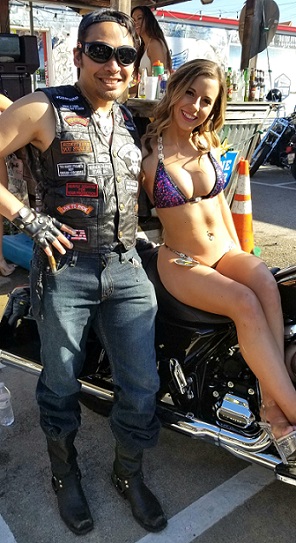
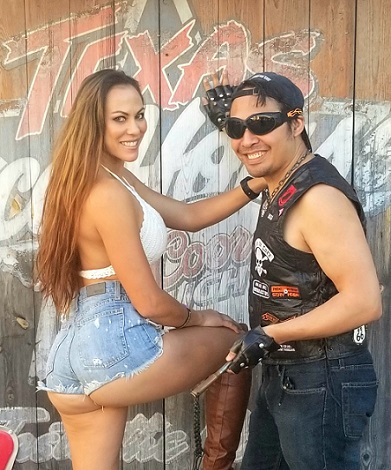
"The few Bike Week participants who are actually one-percenters -- the fashion aristocracy here -- wear their colors. Most leather, however, merely mimics the outlaw biker style by sporting advertisements for one or another brand of motorcycle, patches and pins purchased at bars and boutiques featuring the outlaw style or handed out at toy runs and other charity events organized for motorcyclists. It's no wonder that hardcore bikers lament the faddish popularity of their style:
And what about what used to be the standard apparel? The plain black T-shirts, the engineer boots, jeans with the little battery acid holes. Remember them? Mostly all gone now. Each item replaced by its designer counterpart to impart a carefree sense of tasteful rebellion. In essence, nothing more than a costume that only gets put on to ride the bike. The vest was a place to hang your experiences. These days that $170 vest is nothing more than free ad space for Harley-Davidson.
"Images of the human skull are extraordinarily popular accessories, too. Skulls are the acknowledged touchstones of the entire biker world. As memento mori ('remember that you must die'), human skulls have historically symbolized our own mortality, and they're associated with poison, pirates, evil, and death. But since the advent of outlaw bikers, skulls are most often associated with the outlaw style, communicating danger, and attitude of reckless abandon, and FTW.
"With the successful marketing of nihilism, however, the shock value of skulls has been rendered impotent by their ubiquity -- they're everywhere, grinning, flaming, crying, smoking, scowling, screaming, rotting, jesting, exploding, and flying. Skull pain themes and graphics on custom bikes are everywhere, and even Harley-Davidson offers a factory custom paint job featuring flaming skulls. The number of skull-related products for accessorizing costumes and motorcycles is nothing short of amazing. Like so many other offensive trappings of outlaw nihilism, then, skulls have become conventional and stylish.
"Since nihilism became fashionable, not surprisingly, hardcore bikers are alternately puzzled, amused, or annoyed by what's happened to biker gigs like Bike Week:
Harleys have become a toy for every yuppie rub [rich urban biker] jerk off out there. They get to play 'Biker' without havin' a clue what it's really about. A half million people at Bike Week and maybe fifty thousand bikers at best. Like the t-shirt says, 'You used to hate us, now you wanna be us.' I just hope there's some of us around when they're gone.
"The great irony is that while tens of thousands at Bike Week shell out big money to ape the one-percenter lifestyle, it's a crowd that wants nothing to do with true nihilists. The fact is, that even within the context of Bike Week, most fantasy outlaw bikers would be afraid or embarrassed to be seen with true desperados. And when the party's over, FTW sentiments have to be returned to the closet, covered up, or garaged."
Primary Sources
*
"
Secondary Sources
* Rollin ed. 2006 p80 (Alan R Pratt, "Motorcycling, nihilism, and the price of cool" p76-88)
"Hollywood cashed in on motorcycle-themed nihilism with its version of events in Hollister in László Benedek's The Wild One (1954), the granddaddy of all biker films. Marlon Brando's Johnny, a brooding, surly, self-destructive punk in black leather, would prove iconic. While his Black Rebel gang terrorizes 'Wrightsville,' we learn that Johnny's What-are-you-rebelling-against?-Whad'-ya-got? amorphous nihilism is appealing to women, as sweet Kathie Bleeker discovers. It's a point that would not be lost when fascination with the outlaw biker lifestyle burgeoned.
"American critics of The Wild One feared that the motorcycle-themed glamorization of nihilistic rebellion would prove influential, and they were absolutely right. The success of the film not only introduced the motorcycle rebel to the mainstream, but it also shaped the outlaw biker style and made it cool. And life imitated art. The Outlaw Motorcycle Club's 'Charlie,' the red-eyed skull over crossed pistons, is derived from Black Rebel costumes. In fact, The Wild One, probably more than any other single event, was the catalyst for creating and codifying what would become one of the weirdest nihilist phenomena in American history -- the outlaw biker."
Field Notes
1.