Subject: hunter-gatherer
Culture: British Mesolithic
Setting: Britain 10-5thm BC
Object: frontlet
Yorkshire Museum > After the Ice: Yorkshire's Prehistoric People *
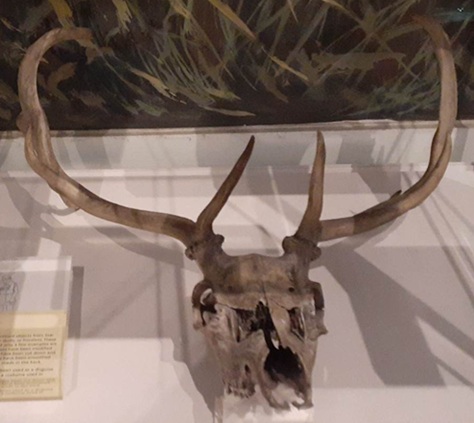
"The most iconic and least understood objects from Star Carr are the 21 worked red deer skulls, or frontlets.
These are a unique group in Britain and only a few examples are known in Europe. The stag frontlets have been modified in a number of ways.
The antlers have been cut down and hollowed. The insides of the skulls have been smoothed down and perforations have been made in the back.
"The frontlets are thought to have been used as a disguise for deerstalking or worn as part of a costume used in a celebration or ceremony."
* Yorkshire Museum > After the Ice: Yorkshire's Prehistoric People
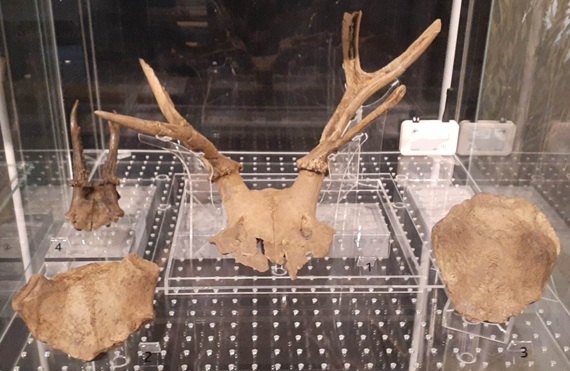
"1. Red Deer Antler Frontlet (Large, with both antlers) Mesolithic (9300-8500 BC) Star Carr, North Yorkshire, 200-2015 ...
2. Red Deer Antler Frontlet (With naturally shed antlers) Mesolithic (9300-8500 BC) Star Carr, North Yorkshire, 2004-2015 ...
3. Red Deer Antler Frontlet (Incomplete, with brain case intact) Mesolithic (9300-8500 BC) Star Carr, North Yorkshire, 2004-2015 ...
4. Roe Deer Antler Frontlet Mesolithic (9300-8500 BC) Star Carr, North Yorkshire, 2004-2015 ...
"The waterlogged conditions at Star Carr caused excellent preservation of organic materials, including bone and antler. Incredible objects, thought to be headdresses, made from red deer skulls have previously been found at this site. 21 were originally discovered, but recent excavations have unearthed many more. This is the first time they have been on public display.
"How are they made? The frontlets are made by removing fur, skin and the lower jaw from the red deer skull with a flint knife. The remaining top part of the skull and the antlers is then covered with clay and placed on a fire. This makes the unwanted parts of bone very brittle and easy to remove. Two holes are then cut into the remaining antlers and front of the skull. These are either for attachment or to see through. This is a long and complicated process.
"Number 3 has not been finished; part of the brain case has not been removed, showing an earlier stage in the production process. Number 4 is made from a different, smaller, species of deer called roe deer.
"The frontlets are all incredibly delicate and are displayed in a specially designed plastic box. Chemicals in the box reduce the oxygen and moisture content in the air to prevent any further decay."