Subject: hunter-gatherer
Culture: British Mesolithic
Setting: Britain 10-5thm BC
Context (Event Photos, Primary Sources, Secondary Sources, Field Notes)
* Ashmolean Museum 2012-01 online > Mesolithic (9600 - 4000 BC)
"The Mesolithic period (or 'Middle Stone Age') in Britain dates from just after the end of the Pleistocene ('Ice Age') approximately 11,600 years ago, to the beginning of the Neolithic period about 4000 calibrated years BC. In England the period is traditionally divided into Early (about 9600-6000 BC) and Later (about 6000-4000 BC) phases mainly based on lithic artefact typologoes and technology. The division is also well-supported by radiocarbon dating and associated palaeoenvironmental evidence.
"People at this time were hunter-gatherers who practised high logistical mobility within what was an increasingly wooded environment. Mesolithic human activity in inland areas, such as Oxfordshire, seems to have been focused along rivers valleys, especially during the later phase.
"Britain was joined to Europe at the start of the period, as it was for much of the preceding Upper Palaeolithic period. The English Channel and North Sea were originally low-lying plains, but were gradually submerged as the climate warmed and the ice from the last glacial period melted. Britain became an island by about 6,000 BC. As the climate warmed, the land also became densely forested with hazel, birch, lime elm and oak, and the large fauna became dominated by red and roe deer, elk and pig."
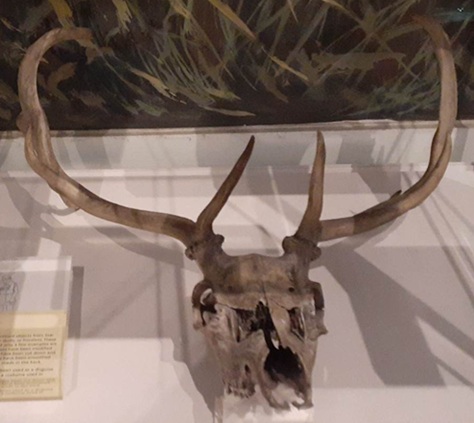
Frontlet
* Yorkshire Museum > After the Ice: Yorkshire's Prehistoric People
"The frontlets are made by removing fur, skin and the lower jaw from the red deer skull with a flint knife. The remaining top part of the skull and the antlers is then covered with clay and placed on a fire. This makes the unwanted parts of bone very brittle and easy to remove. Two holes are then cut into the remaining antlers and front of the skull. These are either for attachment or to see through. This is a long and complicated process."
* Yorkshire Museum > After the Ice: Yorkshire's Prehistoric People
"The frontlets are thought to have been used as a disguise for deerstalking or worn as part of a costume used in a celebration or ceremony."
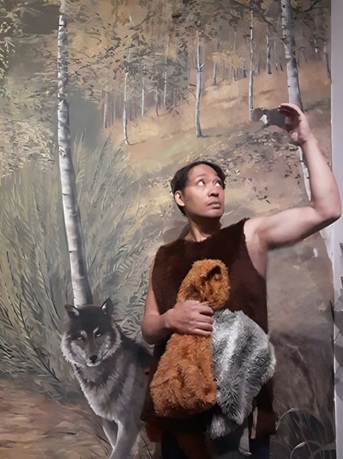
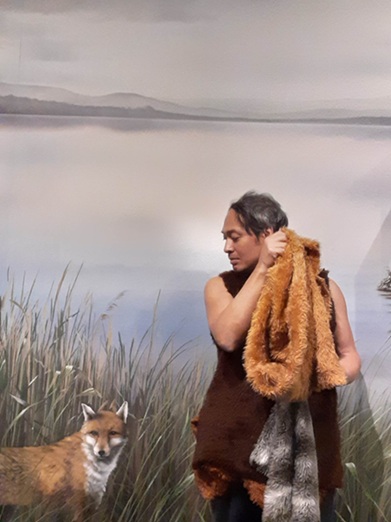
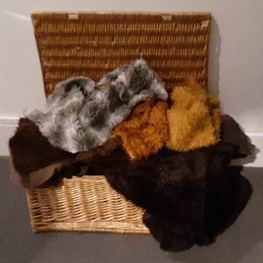
Costume
*
"
Ornaments
*
"