Subject: flaith warrior chief
Culture: Irish
Setting: Irish Iron Age, Ireland late 1stm BC - early 1stm AD
Context (Event Photos, Primary Sources, Secondary Sources, Field Notes)
* Irish Archaeology online > Iron Age
"In Irish archaeology, the Iron Age spans from roughly 400 B.C. to the arrival of Christianity in the fifth century A.D. During this time, significant cultural and technological changes occurred on the island, including the advent of ironworking, which gave the period its name.
"Hillforts are one of the most distinctive characteristics of the Iron Age in Ireland. On hills and promontories, these massive defensive structures were typically composed of a series of earthen banks and ditches surrounding a central enclosure. Some of the largest hillforts in Ireland, such as Dn Aonghasa on the Aran Islands, cover several acres and would have required substantial labor and materials to build.
"The widespread use of ringforts during the Iron Age in Ireland is another significant aspect of this period. These circular earthworks were used as farmsteads or homesteads and consisted of a raised platform surrounded by a ditch. Approximately 40,000 ringforts once existed in Ireland, making them one of the most prevalent forms of prehistoric settlement in the country.
"In addition to these impressive structures, the Iron Age in Ireland is distinguished by the widespread use of iron tools and weapons. This increased agricultural productivity, as iron ploughs could till the soil more effectively, and military capability, as iron weapons were stronger and more resilient than bronze weapons.
"The Iron Age in Ireland witnessed the development of a rich and diverse culture, as evidenced by the discovery of numerous pottery styles and metalwork patterns. Ireland’s Iron Age sites have yielded numerous impressive artifacts, including gold and silver jewelry and bronze and iron swords with intricate designs.
"Despite these advancements, the Iron Age in Ireland was a period of great unpredictability and turmoil. The island was periodically invaded by neighboring peoples, and political and economic instability ensued for centuries. Despite this, the Iron Age’s legacy endures in the numerous remarkable monuments and artifacts that have survived to the present day."
* Wallace 2008 p13
"Beneath the king were the nobles or flaithi. These were warriors and owners of cattle, and had an important role as patrons of the aes dana, the 'men of art', who comprised the learned classes, the poets and musicians, and the skilled craftsmen."
* Daugherty 2015 Celts p215
"The general picture of the Irish Celts is one of proud and warlike people, who raided and feuded with one another on a frequent basis. They also interacted with the Celts of Europe and the rest of the British Isles, with some tribes crossing between Wales, Ireland and Scotland to find new homes or to escape their enemies."
* Kirkpatrick 2026-08-01 online
"Irish Iron Age warfare (≈ 500 BC – AD 400) sat at the heart of early Irish life. Dozens of kin-based túatha—mini-kingdoms scattered across wooded valleys and hilltop forts—measured power in cattle herds and the warriors who could steal or defend them. Dawn raids, hit-and-run ambushes and the occasional clash of massed spears weren’t background noise; they were the motors of politics, trade and legend. When we track these tactics—why cattle functioned as currency, why ring-forts ringed every pasture, why bards glorified single-combat heroes—we uncover an Ireland engineered around mobile warbands, fortified homesteads and fiercely competitive warrior elites.
"[....] Ireland’s Iron Age was a society of warriors and herdsmen, where military tactics were adapted to small-scale, mobile conflict. Ambush, raiding and skirmishing dominated rather than formal set battles. Cattle – the lifeblood of clans – drove much of the warfare, while fortified farms and hilltop enclosures served to safeguard wealth and people. In strategic terms, control of land, cattle and key centres (like Navan Fort and Dún Ailinne) was paramount, and alliances among tribes were fluid.
"Comparisons show Ireland shared the wider Celtic penchant for warrior culture, but lacked the heavy cavalry and urban armies of Gaul or Britain. Roman writers noted Ireland’s military potential yet never challenged it, indirectly confirming a distinct war regime. Mythology like The Táin vividly illustrates Irish Iron Age warfare’s spirit – heroic champions, fierce goddess-portents (e.g. the Morrigan) and, always, the quest for booty – but historians use these narratives only to illuminate beliefs, not as factual accounts.
"Much still lies in the archaeological shadows. Burned gateways and weapon hoards hint at clashes that written sources never record, and debate continues over how often small raids escalated into pitched battle. Even so, every spearhead, ringfort and saga episode points to a society calibrated for mobile conflict—one where kinship, cattle and fortified homesteads forged a distinctly Irish path through the Iron Age and seeded the martial traditions that echo in Ireland’s later history."
* Raftery 1994 p
"
Spear
* Kirkpatrick 2026-07-11 online
"Of all the weapons in the Irish Iron Age arsenal, the spear was the most widespread and versatile. Archaeological finds from across the island suggest it was the principal weapon for combat, ceremony, and status display. Spears also dominate in literary depictions—heroes such as Cú Chulainn are repeatedly portrayed wielding powerful spears, most famously the magical Gáe Bolg.
"Iron spearheads from this period typically measure between 17 and 51 centimetres in blade length and are socketed to attach to long ash shafts. While most spear shafts have decayed, one rare example was recorded at 3.5 metres in length—emphasising the range and reach afforded by these weapons. Spearbutts—metal fittings attached to the shaft’s base—are also found, some in iron and others in bronze.
"Functionally, spears were multipurpose. Ethnographic and classical parallels suggest that light spears (javelins) were used for throwing in the first charge, while heavier lances were reserved for close combat. This dual function aligns with Irish myths in which warriors switch from projectile attacks to hand-to-hand fighting as battles intensify. Literary sources also indicate that each warrior may have carried multiple spears—highlighting both their utility and symbolic value."
Sword
* Thompson 2013 p39
"Irish warriors of the era in which the Tain is set (around the same time as the life of Christ) would have used short cut-and-thrust swords of between 14 and 20 inches in length. By the era in which the earliest sections of the Tain were composed, the Irish had adopted modified versions of the swords they would have seen during their piratical raids against Roman Britain. However, these were still short cut-and-thrust swords, maxing out at about 28 inches. The military technology had not evolved to the point where sword technique would have been drastically different. If the Tain and the other sagas incorporated stock phrases describing combat (which is a typical mnemonic feature of epic recitation), then broadly accurate descriptions of sword use could have been 'fossilized' in the story for centuries before it was written down."
* Kirkpatrick 2026-07-11 online
"Swords in Iron Age Ireland were relatively short by European standards. Most measured between 16 and 62 centimetres in blade length, significantly shorter than the metre-long slashing swords used in Gaul or Roman military contexts. These Irish blades typically featured double edges, tapered points, and occasionally La Tène-style hilts or pommels. Scabbards—usually bronze—have also survived, although many swords are found without their fittings, suggesting either disintegration or deliberate stripping before deposition.
"One of the best-known examples is the Dún Ailinne sword from County Kildare. While typologically La Tène (3rd–2nd century BC), it was deposited in a 1st-century AD context. The Lisnacrogher hoard (Co. Antrim) yielded several finely crafted swords and scabbards, indicating both the functional and symbolic status of these items. Metallurgical analysis reveals a wide quality range: from crude utilitarian pieces to carefully forged prestige weapons.
"Interpretation of their use varies. Contemporary studies emphasise that Irish Iron Age swords were notably short, and this feature has led scholars to interpret them primarily as thrusting weapons suited to close-quarters combat. However, literary traditions—such as tales from the Ulster Cycle—often depict warriors using both spear and sword, with the sword drawn once the spear breaks. This dual-weapon strategy aligns with classical accounts of Celtic warfare, where swords were backup weapons rather than primary arms."
* Thompson 2013 p40-41
"Irish swords were very different from the swords used by the Gauls, Britons or Caledonians. The Irish weapon was much shorter -- we would probably think of it as a very large knife rather than a sword -- and it could thrust just as well as it could cut. However, Irish warriors in the sagas still use a lot of cuts:
Heroes swayed to this side and that, each circling the other as they sought opportunity for a blow. The battle champions rose again over the rims of their emblazoned shields. Their courage grew, and the valiant virulent men became steadfast as an arch. Their hands shot up with their swords, and they fenced swiftly about the heads of warriors, hacking their helmets. (Cath Magh Tured)
"This passage from 'The Battle of Moytura' gives us a vivid picture of what an Irish swordfight would have looked like. The warriors circle each other warily with raised swords, feinting and watching for a chance. Suddenly they close in on each other with a flurry of blows targeting the head, the face and the neck, striking rapidly from one side to the other.
"This picture is confirmed by all of the other Irish sources. The sagas present a consistent picture of this type of sword combat, sometimes with more detail and sometimes with less."
* Thompson 2013 p21
"Ancient Irish swords were much different from La Tène broadswords. They had sharp thrusting tips as well as edges for cutting, and were much shorter. Several examples are discussed in 'The Lake Dwellings of Ireland' by William Gregory Wood-Martin, and measurements are given.
"One example was 253/4" overall length, with a blade 11/2" broad and a 31/2" grip. Another example was a 23" 'crannog sword' with a 4" handle. Another example was 211/2" overall length, and still another was a mere 141/4" overall length.
"Apparently, Irish warriors began carrying longer swords modeled after the gladius and spatha after tangling with the Romano-British who used these weapons, but ancient Irish swords never got any longer than about 28"."
"Celtic swords (and daggers) with anthropomorphic hilts were produced during the La Têne C/D period (2nd c. BC – early 1st c. AD), and have been found across the continent stretching from northwestern Ireland to the Balkans, indicating that they gained popularity among all the pan-Celtic European tribes during this period."
Shield
* Kirkpatrick 2026-07-11 online
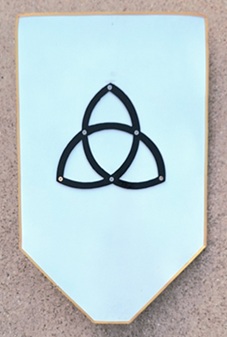
In the Iron Age Irish warrior’s toolkit, the shield served both as a practical defence and a symbolic object. Though far fewer shields survive than spearheads or sword fragments, what evidence we do have offers valuable insight into the role and design of defensive gear.
"The most famous example is the Clonoura shield, discovered in a bog in County Tipperary and dated to around AD 30–60. Made of alder wood and covered in leather, it measures approximately 67 × 38 centimetres—small by Continental standards. Its cut marks and punctures show it was used in actual combat. This rare survival suggests at least some Irish shields were compact, light bucklers, likely suited to mobile close-quarters fighting rather than long engagements behind a shield wall.
"Elsewhere in Ireland, fragmentary shield components have been found, including wooden ribs and bronze bosses. These reinforce the picture of small, round or oval shields, held with a central grip. The absence of larger or heavier examples—such as the 1-metre-plus oval shields seen in Gaul or among Roman troops—points to a distinct insular fighting style, likely based on agility and personal combat."
* Thompson 2013 p20-21
"We don't have a lot of information on Irish Iron Age shields due to the lack of archaeological evidence, but an Irish rectangular shield found at Clonoura was 22.4 inches high by 13.8 inches wide.
"Small rectangular shields very similar to the Clonoura shield are shown on some of the Pictish stone carvings. An image from the Book of Kells shows an Irish warrior with a spear and buckler, so we know the buckler was used as well."
Jewelry
* National Museum of Ireland -- Archaeology > Ireland's Gold
"Ór san Iarannaois Nuair dhéantar comparáid les an gCré-Umhaois, is méid an-bheag de na hornáidí déanta as ór ar féidir dáta na híarannaoise a chur leo. Bhí méid an-ard d'airgead sa chóimhiotal óir ar baineadh úsáid as, le 25%-30% coitianta, rud a dhéanann inaitheanta go héasca nach ón gCré-Umhaois iad.
"Is beag an mhéid de chineálacha éagsúla déantán a rinneadh chomh maith ach fós is gá go mbeadh taithí acu siúd a dhéanann iad agus go mbeadh siad an-oilte. Is iad toirc ribín an déantán is comónta ón tréimhse seo. Deantar na bíseanna dlúthchasta seo as bandaí nó leatháin óir. Is in Éirinn agus in Albain amháin atá siad seo. Thángthas ar roinnt taiscí móra, lena n-áirítear ag Learga an traonaigh agus Inis Eoghan i gCo. Dhún na nGall. Chun torc ribín a dhéanamh, tá gá le scil shaothraithe darb ainm ardú frithschlastach, déanann an t-órcheardaí buntréithe an mhiotail a úsáid chun é a shíneadh, a chrapadh, a chasadh agus a lúbadh le réimse mór toirc a dhéanamh idir mhéid agus mheáchan.
"Rinne órcheardaithe Gaelacha stíleanna agus teicnící aitheanta ó dheisceart na Fraince a chóipeáil chun ornáidí taibhseacha don mhuineál a dhéanamh cosúil leis an gceann ó Bhrú Íochtair, Co. Dhoire. Rinneadh ornáidí muiníl óir eile a iompórtáil ón domhan Rómhánach."
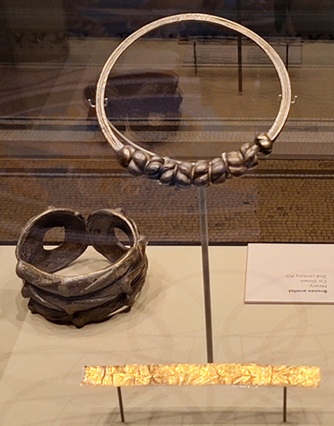
"Gold in the Iron Age The number of ornaments made from gold that can be dated to the Iron Age is very small when compared to the Bronze Age. The gold alloy used was very high in silver with 25%-30% common making it easily distinguishable from Bronze Age gold.
"The types of objects made are also very few in number but still require great skill and experience to produce. Ribbon torcs are the most common artefact of this period. These tightly wound spirals are made from bands or strips of gold. They are found only in Ireland and Scotland. Several large hoards containing only ribbon torcs have been found including Largatreany and Inishowen in Co. Donegal. To make a ribbon torc requires a highly developed skill known as anti-clastic raising whereby the goldsmith uses the inherent qualities of the metal to stretch, contract, twist and turn to produce torcs of many different sizes and weights.
"Irish goldsmiths also copied styles and techniques known from southern France to produce extravagant neck ornaments such as the one from Broighter, Co. Derry. Other gold neck ornaments were imported from the Roman world."
Costume
* Kirkpatrick 2026-07-11 online
"Spanning some 700 years (200BC-500AD), to describe Iron Age clothing in Ireland in any single way is always going to commit errors of oversimplification. But there are certain trends which historians and archaeologists have identified. Taking these as our startling point, we can begin to image the ways in which local particularities and seasons would have shaped these. To begin, the historian Kenneth Jackson provides a succinct summary:
“The men wore a long woollen mantle pinned at the neck with a brooch of silver or gold decorated with engraving or gems and underneath, a tunic reaching to the knee… The women also wore mantles, and tunics to the feet, and did their hair in two or three plaits fastened with decorated beads.”
P.W. Joyce gives a slightly different account, describing a typical ancient Irish outfit as consisting of four key parts:
1. A loose cloak without sleeves usually covering the whole person
2. A fitted coat or jacket with sleeves but no collar
3. A shoulder cape or sometimes hooded
4. A kilt similar to those used by Scottish clans today
Both men and women would have worn some combination of these four garments. There were also undergarments and trousers, but its these four garments which appear most frequently in the historical narratives and archaeological record. Indeed, the closeness to our own fashion is easy to see, with coats, jackets, jumpers, t-shirts, trousers, shorts, and skirts, all finding their place in this ancient Irish wardrobe, albeit in different shapes and forms."