Subject: warrior
Culture: Irish
Setting: Irish Late Bronze Age, Ireland late 2nd - mid 1stm BC
Evolution:
Context (Event Photos, Primary Sources, Secondary Sources, Field Notes)
"By the Middle Bronze Age (MBA hereafter), Ireland can be considered part of the general ‘Atlantic Bronze Age’ tradition (Briard, Reference Briard 1965; Cunliffe, Reference Cunliffe 2001; Harrison, Reference Harrison 2004: 11), which includes dispersed settlement with isolated roundhouses (but see Ginn & Rathbone, Reference Ginn and Rathbone 2012), hillforts in some areas (Grogan, Reference Grogan 2005), mortuary practices with poor archaeological visibility (Schulting & Bradley, Reference Schulting and Bradley 2013), and a predisposition towards ‘male’ objects in the bronze industry (Sørensen, Reference Sørensen and Jorge 1998: 262; Harrison, Reference Harrison 2004). The island has the densest concentration of Bronze Age swords in Europe, and probably weaponry more generally, and a high proportion of the bronze consumed went into weapons and tool-weapons (Chapman, Reference Chapman, Carman and Harding 1999; Harding, Reference Harding, Otto, Thrane and Vandkilde2006, Reference Harding2007; Becker, Reference Becker 2013). The visibility of settlements in Ireland has always been problematic, primarily because they are dispersed and village sites are exceptional (Ginn & Rathbone, Reference Ginn and Rathbone 2012). A major shift in settlement focus took place by the thirteenth century bc, when hillforts began to be constructed in parts of the country, some at least being habitation sites. The importance of these may relate to their role in physically demarcating central places in prominent topographic locations that visually dominate the landscape and river courses (Grogan, Reference Grogan 2005). The archaeological record for MBA and Late Bronze Age (LBA hereafter) Ireland is poorly suited for analyses of social differentiation of (specific) individuals and hierarchization of society, but this may be tempered by the evidence for a growing complexity in traditions of warfare and the emergence of defensible central places. Magnificent individual items, such as large gold gorgets, and the capacity to assemble and deposit the Mooghaun hoard of gold personal ornaments, also imply the existence of archaeologically ephemeral elites (Waddell, Reference Waddell 1998: 273–75).
"Extensive typo-chronological work has been conducted on Irish bronze weaponry for over a century, though critical analysis of linked social practices is rare (Wilde, Reference Wilde1863; Coffey, Reference Coffey 1894; Eogan, Reference Eogan 1965, Reference Eogan 2000; Harbison, Reference Harbison 1966, Reference Harbison 1969). Analyses of depositional contexts and environments have proven fruitful (Eogan, Reference Eogan 1983; Bradley, Reference Bradley 1990, Reference Bradley 2007; Becker, Reference Becker 2013), although work has rarely addressed the social conditions of the routine use of these things or considered them as parts of a package of complementary material culture linked through social practices. Despite the quantity of weaponry and the quality of its survival, therefore, the history of research into Irish Bronze Age warfare is negligible."
Spear
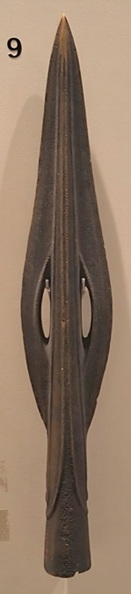
"LBA spearheads retain the tradition of intentional diversity, and the characteristic external socket loops are shed in favour of an internal peg. The nomenclature for these spearheads is diverse, with no detailed typological analyses to date. During my PhD research they were broadly divided into three groups—lanceolate, broad, and stumpy. The first is defined by a narrow, relatively even, elongated oval shape, quite like a willow leaf. The second (broad) group of spearheads have a socket that makes up some 25–50 per cent of the length of the entire object, and the blade is leaf-shaped. The third type (stumpy) was so named for the short sockets in relation to the flame-shaped blade, being in the region of 10–15 per cent of the entire length of the object; they have a ridged or faceted midrib. In all cases, the socket continues to just short of the tip of the blade. In general terms, the lanceolate variety tends to be around 17–27 cm long and weighs some 100–200 g, though shorter examples of around 9–13 cm occur. The broad variety falls into a range of around 10–13 cm (usually in the region of 100 g) and 20–32 cm (usually 200–350 g), with examples over 40 cm long representing exceptionally large spearheads (weighing over 500 g). The stumpy variety has the same range, though clustering around 10–23 cm and having a similar length to weight ratio as the broad spearheads, with occasional longer examples in the same metric range. Some of the more visually striking examples of LBA spearheads are the pieces with lunate openings in their blades. These are generally considered together as a distinctive group (e.g. Becker, Reference Becker 2013), though it is clear that the lunate feature occurs in all three general groups, suggesting that it had a social meaning that cut across the distinct shapes of the spearheads.
"A general functional assessment would see the lanceolate variety being geared towards light spears; the other two varieties are slightly more diverse because they include particularly long and heavy examples, though they are commonly broadly consistent with the functional length and weight ranges of the lanceolate variety. There was a general tendency towards shorter and more robust proportions compared to spearheads of the MBA tradition. It is also harder to see significant functional differences in the LBA spearheads compared to the MBA examples, but diversity of form clearly remained socially relevant. Some spears of these ‘earlier’ traditions no doubt overlapped with the newer tradition for a time, as illustrated in hoard associations. While there is therefore no typical LBA spear, there is a greater inclination towards pieces best suited to hafting on long shafts—reducing the possibility of assegai-type weapons—and appropriate for single-handed use, including throwing. The potential for cutting attacks is retained, but is perhaps less important."
Sword
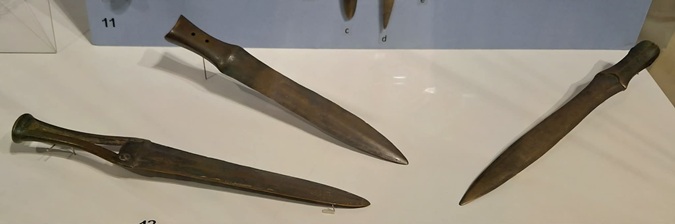
"Swords related to continental Erbenheim and Hemigkofen grip-tongue forms come into use in Ireland from the twelfth or perhaps eleventh century bc, which Eogan respectively calls Class 2 and 3. The former are comparatively long, but rare, and the latter have squatter and wider proportions and, while relatively rare, have a wider distribution. Chronologically and typologically it is not entirely clear in which direction the influence between the Group IV Type Cutts, Class 1, and Class 2 moved, and how Class 4 relates to any of these or to its closer Class 3 relative. A greater role for indigenous development including the particular leaf shape/geometry of the blades, or indeed entangling of traditions (Hodder, Reference Hodder 2012; Stockhammer, Reference Stockhammer, Maran and Stockhammer 2012), within the workshops of Ireland and Britain may simplify the local sequence and relate to bilateral east-west exchanges of technology and martial traditions in Europe (Cunliffe, Reference Cunliffe 2001).
"In terms of functional characteristics, some Class 1 swords appear to share similar proportions with Class 2, whereas others (more commonly) share features with Classes 3, 4, and 6 swords. Class 1 swords were c. 45–55 cm long and weighed c. 450–550 g, Class 2 were 60–67.5 cm long and weighed 600–800 g, and Class 3 were 48–60 cm long and weighed 400–500 g, suggesting a general move away from MBA swordsmanship with lighter weapons between the thirteenth and eleventh centuries bc. This deviation, if it is real, appears to be reversed when the distinctly local Class 4 sword develops by the eleventh century bc (Needham et al., Reference Needham, Ramsey, Coombs, Cartwright and Pettitt 1997) when virtually all trace of Class 2 disappears and a distinct bias towards short and light swords emerges. Class 4 incorporates the vast majority (over 70 per cent) of swords recovered from Ireland and these were notably shorter and lighter than the typical European (and British) LBA sword (Waddell, Reference Waddell 1998: 237–38; Colquhoun, Reference Colquhoun, Uckelmann and Mödlinger 2011; Molloy, Reference Molloy, Uckelmann and Mödlinger 2011). Within this general framework it also becomes clear that regional preferences existed within the island in terms of length and weight of swords (Molloy, Reference Molloy, Uckelmann and Mödlinger 2011: figs 1–3), which broadly reflect ‘provinces’ identified through other artefact research (Grogan, Reference Grogan 2005: 169–72), though North Munster is divided.
"When we link this back to the messy transition phase from MBA swords, we are reminded of the comparative preference for swords of the shorter Class 1 and 3 tradition over and against the longer Class 1 and 2 pieces. The short, light, and rapidly deployed Class 4 swords may be seen as having a close functional link, if not continuity, with the fighting traditions of the MBA. Following Melheim and Horn (Reference Melheim and Horn 2014: 5), we should bear in mind that it is insufficient to analyse the adoption of a new object form without giving due recognition to the transformations in body techniques required to use it effectively. Craft and martial art traditions may thus be seen to develop in tandem and to be capable of integrating established traditions and new influences in dynamic ways. This, in turn, can be reflected in developments in the functional capacities of weapons that are not visible in typo-chronological studies.
"At a later stage in the LBA the Gündlingen/Eogan Class 5 sword emerges ‘fully formed’ by the eighth century bc. These swords have no lineage in the bronze swords of Ireland and may have been a bronze ‘response’ to the earliest iron swords. In length they range between 58 cm and 84 cm, the average being 67.3 cm and they are commensurately heavier than the shorter Class 4 and 6 swords. There are two main functional categories. One has a wider blade with thin and distinct cutting edges, while the other has a much shallower and oblique edge on a thin blade (Molloy, Reference Molloy 2006: 96). For the second group, a bias towards thrusting attacks is pronounced. Nonetheless, both types were suited to cutting, but using somewhat wider arcs (on the basis of their length) than the typical bronze swords of the earlier LBA. Class 6 swords continue the Class 4 tradition contemporary with the use of Class 5 swords.
"While LBA swords clearly used different cutting dynamics from their predecessors, the way in which they developed in Ireland indicates that the traditions of use of MBA swords remained influential and this affected the proportions of the later weapons. Notably novel features include the curved cutting edges, full hilt, and bias towards heavier blades. The curved edges enable the sword to bite deeper as it is drawn along a target by incrementally increasing the depth of the cut (Molloy, Reference Molloy and Molloy 2007). The curvature assists cutting when using either edge; the fact that having two such edges creates a leaf-shaped blade is a secondary characteristic. Supporting this, many blades have a distinct distal taper the thickness of the cross-section by 1–1.5 mm from the blade at its narrowest near the shoulders to its broadest width, so that the mass is intentionally reduced at this broadest section. I have previously demonstrated (Molloy, Reference Molloy 2006, Reference Molloy and Molloy 2007) that these swords could potentially cut through bone, but that their main utility appears to have been to slice soft tissue targets such as muscles, tendons, and blood vessels. Effective cutting was only possible when the blade was drawn along a target because axe-like percussive strikes had little effect on the test-cutting media. This in turn requires a controlled strike that aligns the cutting edge squarely with the motion path of the blade so that a cut is executed in a smooth linear motion. Considerable practice and handling of swords is needed to achieve this, and evidence for such practice and training more generally may be seen in the wooden training sword from Cappagh, Co. Kerry (Waddell, Reference Waddell 1998: 280; Molloy, Reference Molloy and Molloy 2007: 102; https://skfb.ly/TNRG). Length-for-length, these swords could make more effective and damaging cuts than their predecessors, but not dramatically so. As a consequence of their length, they remained very close-quarter weapons.
"Bridgford (Reference Bridgford and Carman 1997: fig. 7) has demonstrated that many Irish swords had combat damage, though very few had (her) level 4 or 5 damage (1 being none), a pattern I also observed when examining these swords (Molloy, Reference Molloy2006). Given the risk of damage at each and every blade-to-blade contact, it may be expected that LBA swordsmanship styles continued MBA traditions that minimized heavy impacts. The damage that we find on LBA swords (Figure 6), like those of the MBA, is rarely severe (except on examples that have been intentionally disfigured or ‘killed’) and it is common to find a variety of forms of damage along a blade, few of which were more than 1 or 2 mm deep (see: 3D models of sections of blades from NMI W93: https://skfb.ly/IKrr and NMI W14: https://skfb.ly/IKrp). It can nonetheless be observed that as many as one in six swords has a broken hilt (Eogan, Reference Eogan 1965), which could indicate in some cases that material fatigue or failure from training or fighting occurred even when edge-on-edge type damage is absent."
Shield
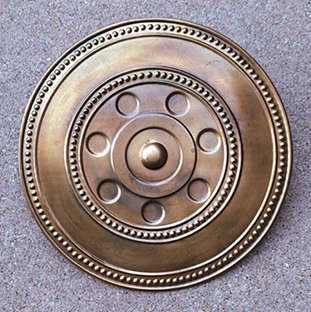
"Three main materials were used for making shields: wood, leather, and metal. The MBA tradition of leather shields continues, seen in the shield former from Churchfield, Co. Mayo, dating from the fourteenth to twelfth century bc, and the leather shield from Clonbrin, Co. Longford, dating from the twelfth to tenth century bc (Needham et al., Reference Needham, Northover, Uckelmann and Tabor 2012). Alongside these is a wooden shield found at Annadale, Co. Leitrim, dating from the thirteenth to eleventh century bc (see: 3D model: https://skfb.ly/NYyA). At least four metal shields are also known from Ireland, two large and two small, dated stylistically to the LBA.
"Shield functionality has been discussed in depth elsewhere (Molloy, Reference Molloy 2009; see also Needham et al., Reference Needham, Northover, Uckelmann and Tabor 2012; Uckelmann, Reference Uckelmann 2012), and here it is sufficient to restate that these were defensive weapons used to deflect or intercept attacks and also to control space—both between a warrior and their opponent and between warriors on the same side. A shield can also be used to strike an enemy, either by buffeting them with the flat or using the very thin, often blade-like, edge to strike directly. As with armour, a shield is not intended to stop the user from being injured, but rather to combine a reduction in the chances of being injured with the ability to inflict injury.
"Leather shields were effective for combat, being light but durable (Coles, Reference Coles 1962). Cuts to the face of the shield only cause minimal scratching, but my experiments show that repeated striking to the quadrant where a right handed attacker would hit most frequently can lead to material degradation and eventual bending of the shield. The edges are also susceptible to being cut into. All three forms of damage are clearly visible on the surviving leather shield from Clonbrin (Molloy, Reference Molloy 2009). The fibrous composition of the shields and the fact they pivot on a single holding point behind the boss makes it difficult to penetrate them with a spear, though it is, of course, possible; hence, despite the c. 5 mm thickness of the Clonbrin shield, a second sheet of leather is stitched across the boss to protect the hand. It is probable that making a single-layer leather shield of a larger diameter would be increasingly susceptible to bending and the Clonbrin shield is close to the maximum diameter possible for this design.
"There is no clear evidence for use-wear on the wooden shields from Ireland. The Annadale shield was a functional wooden example, being 10–20 mm thick and just under 2 kg in weight. It was made of alder, a softer hardwood that absorbs blows without cracking easily and is relatively light for its size. It is noteworthy that the metal shields from Lough Gur, Co. Limerick, and Barry Beg, Co. Roscommon, had diameters and weights similar to those of the Annadale piece, indicating that there was a relatively standardized level of coverage and manoeuvrability for this larger shield type, irrespective of the material used. On the basis of its size to weight ratio, it is unlikely that the Cloonlara wooden shield was a functional weapon (Molloy, Reference Molloy 2009).
"Experimental work (Molloy, Reference Molloy 2009) and metallographic examination (Needham et al., Reference Needham, Northover, Uckelmann and Tabor 2012) suggest that metal shields had the capacity to be used in combat, a contention supported by metalwork wear analyses. The Type Yetholm bronze shields from Barry Beg and Lough Gur have damage to their face consistent with a blade thrust/stab (Uckelmann, Reference Uckelmann 2012: nos. 31 and 38 respectively). The location of the suspension tabs on these shields indicates that top and bottom were distinct, with the handle held vertically. On the Barry Beg shield, weapon-inflicted damage (probably from a sword) occurs on the inside half when held in front of the chest (the right-hand side when looking from the back), and possibly just above the handle. On the Lough Gur shield, it is not possible to ascertain the nature of the damage because corrosion has exacerbated ancient damage and this was conserved following recovery in the nineteenth century. It is worth noting, however, that the damage is located in the same areas as on the Barry Beg shield. Because only two examples survive from Ireland, we can look to the British Yetholm shield series for comparison. Examples from Burringham Common, Langwood Fen, London (two shields), and Sutton have damage that is notably biased towards the same zones as the Irish shields (Uckelmann, Reference Uckelmann 2012: nos. 36, 40, 41, 42, and 46 respectively). The two London shields have what appear to be both spear- and sword-inflicted damage to the face and in the same region as the Irish shields, though instances of deliberate damage are also clear on at least one of the London shields (Uckelmann, Reference Uckelmann 2012: 173–78).
"A Yetholm shield would cover the torso from the throat to the groin. At a thickness of around 0.7–1 mm, the body of the shield was quite thin, balancing the provision of spatial coverage with maintaining a weight of around 2 kg. The edge of the shield was rolled around a wire to provide a surface of some 4–6 mm to ward off cutting attacks to the edge. It is difficult to land an effective cut to the face of the shield due to its width being capable of creating a large contact area which distributes the force of cutting attacks (Figure 8). A cut would, therefore, preferentially (but not exclusively) need to lead with the point rather than the edge to gain purchase and damage the shield. Penetrative attacks by spear or sword thrusts would be effective, and reflect the main form of damage seen on surviving metal shields in Ireland and Britain. We may predict such damage to be biased towards the area covering the throat and chest for such thrusting attacks, particularly if used cooperatively in a set formation (such as a shield wall). Damage biased towards this location is noted on Figure 9.
"The most robust shields of the LBA are the small buckler-type exemplars made of bronze that range from 1 to 1.5 mm in thickness. These can be around 30 cm in diameter and they are around half the weight of larger shields at about 1 kg. These Athenry-Eynesham types typically have unrolled edges, which forms a blade-like edge with which to strike. They provided virtually no ‘static’ coverage and, therefore, had to be used actively to engage with an opponent and their weapons. The two traditions of metal shield enable two very different ways of fighting: the large shields were suited to cooperative styles such as a rudimentary shield wall, the small ones actively discouraged this and required more mobile environments. This small collection of finds therefore implies that more than one form, and potentially context, of combat existed in the LBA."
Jewelry
* National Museum of Ireland -- Archaeology > Ireland's Gold
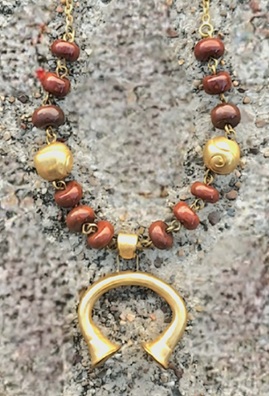
"An Chré-Umhaois Dhéanach 1200-500 R.Ch. Thart ar 1200 R.Ch. tháinig athruithe móra ar an órcheardaíocht de thoradh ar thionchair ón Eoraip agus níos faide i dtreo an Oirthir. Táinig ann d'ornáidí casta, idir mhór agus bheag, ar a dtugtar toirc agus cé gur leanadh le saothrú leatháin ba shaothar de shaghas níos troime é.
"De réir mar a d'fhás obair an órcheardaí sna céadta ina dhiaidh sin, tháinig forbairt ar obair na gceardaithe cré-umha chomh maith agus d'fheabhsaigh siad a scileanna agus iad ag táirgeadh raoin mhóir de thuanna, de shleánna, de choirn agus de choirí. Rinneadh earraí a bhain le hornáidíocht phearsanta freisin, ar nó bioráin lus gréine.
"Braithimid ón mborradh a tháinig ar tháirgeadh thart ar 800 R.Ch. go raibh rachmas ann. Bhí an rachmas seo cruinnithe i bhfoirm ornáidi troma óir ar nós fáisciní gruaige agus spóil chluaise -- slán toisc gur cuireadh i dtaisce iad d'aon ghnó i bportaigh agus ar láithreáin ar thalamh tirim.
"Faraor, de dheasca easpa fianaise adhlachta, táimid fágtha gan eolas a thabharfadh tuiscint dúinn ar fheidhm na n-earraí agus ar eagar na sochaí saibhre seo. Mar sin féin, insíonn na hearraí dúinn faoi scil agus faoi chlisteacht na gceardaithe ach táimid dall ar a n-úinéiri agus ar lucht a gcaite."
"Late Bronze Age 1200-500 B.C. At about 1200 B.C. strong influences from Europe and further East resulted in major changes in gold working. Large and small twisted ornaments called torcs began to be made and while work in sheet gold continued it was of a much heavier form.
"As the work of the goldsmith expanded through the following centuries the bronze smiths also developed and refined their skills producing a great range of axes, spears, swords, horns and cauldrons. Objects of personal ornament in bronze such as sunflower pins were also made.
"The remarkable expansion in production which took place around 800 B.C. suggests that there was great wealth available. This wealth was concentrated in the form of heavy gold ornaments such as dress-fasteners and displayed in highly decorated gold collars. This immense inheritance of gold bracelets, dress-fasteners, collars, hair-rings and ear-spools survived as a result of deliberate deposition in bags and on dry land sites.
"Unfortunately, the lack of burial evidence deprives us of information which could help us to understand the function of many objects and the organisation of this rich society. However, while the objects tell us of the skill and ingenuity of the craftsmen their owners and wearers remain hidden from us."
* National Museum of Ireland -- Archaeology > Ireland's Gold
"An Chré-Umhaois Dhéanach 1200-1000 R.Ch. Thart ar an mbliain 1200 R.Ch. tháinig athrú suntasach ar na cineálacha ornáidí a dhéantaí sna ceardlanna. Forbraíodh teicnící órcheardaíochta nua agus thánig ann do stileanna nua. Feasta ba é casadh a bhaint as stiall nó barra óir an teicníc ba choitianta a úsáideadh agus is féidir raon mór castaí a fheiceáil. Rinne na hórcheardaithe raon mór déantán idir bheag agus mhór ó fháinní cluaise go toirc choime. Theastaigh an oiread sin de mhéideanna móra óir leis na hornáidí seo a dhéanamh go meastar gur aimsíodh foinse nua óir. Ag an am céanna leanadh de bheith ag úsáid leatháin throm óir mar is léir ó na muincí dóide ollmhóra."
"Late Bronze Age 1200-1000 B.C. At about 1200 BC there was a remarkable change in the types of ornaments made in the workshops. New gold-working techniques were developed and new styles began to appear. Twisting bars or strips of gold became the most commonly used technique and a great variety of twists can be seen. The goldsmiths produced objects varying in size from earrings to waist torcs. Many of these ornaments required the use of very large amounts of gold suggesting that a new source for gold had been discovered. Meanwhile the use of heavy sheet gold continued as can be seen in the massive armlets."
Ax
"The context in which some LBA socketed axes were found is useful for assessing possible functions. Irish hoards are notoriously difficult to study because of their heterogeneity (Becker, Reference Becker2013). This said, in the hoards from Blackhills, Dreenan, and Tuam (Eogan, Reference Eogan1983: nos. 269, 258, and 322), for example, we find a range of weapons, personal ornamentation, and tools that could represent the belongings of an individual, even if the objects were brought together to simply express this concept for depositional acts rather than being actual personal belongings. If there is martial symbolism relating to individual identities at work in these particular deposits, then the axe played a role. While axes remain in the category of Chapman's (Reference Chapman, Carman and Harding1999) tool-weapons, those that belonged to warriors could have been used for acts that included combat. The long-standing tradition of stone percussive weapons in Ireland and contemporary bronze battle-axes in Europe provides a context for this assertion."
Dagger
"Many copper and copper-alloy dagger forms, differentiated by typological niceties, are known from Europe in the late third to early second millennium bc. As general purpose tools they would have had many uses including, but not restricted to, fighting. The earliest daggers in Ireland had quite flat cross-sections in the general ‘Beaker’ tradition and ranged from pieces with blades a few centimetres long to examples with blades over 20 cm, constituting serviceable weapons. While little edge wear is visible on any daggers from this period (Thorpe, Reference Thorpe, Harding and Fokkens2013), blade-on-blade impacts are unnecessary for dagger combat and, because flesh and bone are not prone to causing damage, it can be difficult to measure their functions in combat.
"In general terms, with no reason to expect a complex martial milieu surrounding their use, daggers could have been used in a manner broadly equating with open-hand/unarmed strikes with the fist (Peatfield, Reference Peatfield and Laffineur1999). While the increased lengths of early metal daggers afforded new combat possibilities, the general pattern of use is correlated in the lithics industry, particularly with regard to flint daggers/spearheads (Frieman, Reference Frieman2014). Metal daggers were less susceptible to breakage than lithic ones, yet should the latter snap in a wound this could lead to secondary injury or subsequent infection (Frieman, Reference Frieman2012: 446). A midrib develops on metal daggers by the end of the EBA, which served to strengthen them for combat use and paved the way for crafting swords in the MBA."
Costume
*
"