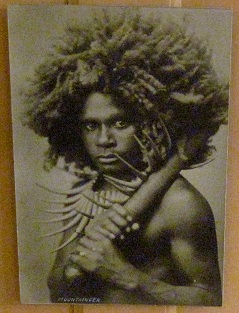
Subject: koroi 'killer'
Culture: Fijian
Setting: tribal warfare, Fiji late 18th-mid 19thc
Event Photos
* Archey 1967 p69
"The Fijians gave place to no other South Sea people in hospitality, or in their observance of ceremonial feasts, for which enormous supplies of food were prepared for preprandial displays on racks, like Maori food-stages. As soon as the guests were assembled and the gathering had been called to order, the distribution of the food was made in strict accordance with recognised rank and precedence. You may be sure the proceedings were closely followed, for the Fijians were as jealous of social status as Melanesians and Polynesians anywhere. Unintentional slights, nursed as grievances, became magnified into deliberately planned insults, and not infrequently found their ultimate outlet in fierce and ruthless fighting."
* Archey 1967 p71-72
"Another restricted cult is that of the Nubuki, a secret initiation ceremony for youths, performed on a rock-walled platform area with a stone pyramid in the manner of a Polynesian marae. There were three degrees of initiation: youths, men, and priests, and the rite consisted essentially of the simulation of death and revival -- a kind of ancestor worship. The formal ceremony was followed by an orgy, and recalls the similar licentiousness in the Tahitian areoi societies."
Primary Sources
"Many of the 19th century accounts that still shape some of our perceptions of cannibalism were written by Western missionaries who provided horrified descriptions of what they had seen, but limited explanations for why people actually ate human flesh. Such depictions of people, like the Fijians, as “savages” who needed to be saved from themselves, were often used to further the case for converting them to Christianity, and also to justify colonisation. Cannibalism was a feature of a number of societies around the world and the reasons why people participated in it were diverse: it was sometimes used as a form of punishment or revenge against one’s enemies; in some places other forms of meat were very limited and it may have been necessary to eat human flesh at times in order to survive; some believed that the strengths and qualities of the person consumed could be transferred to the one who ate them and for others it was a way of honouring the dead or the Gods and formed part of their religious rituals."
Secondary Sources
*
"
Field Notes
1.