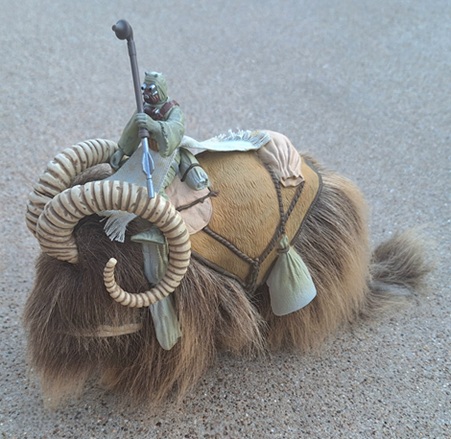
Subject: tusken raider / sand person
Culture: American sci-fi fandom
Setting: Star Wars
Context (Event Photos, Primary Sources, Secondary Sources, Field Notes)
"The Tusken Raiders, also known as Sand People, are the indigenous people of Tatooine. The inhospitable desert planet on which Anakin and Luke were born wasn't always populated by traditional human beings. They're broadly humanoid, but heavy clothing always obscures their form. They've lived on Tatooine for untold ages and tend to be hostile toward the settlers. Life in the harsh desert has led the Sand People to a life of strict rituals. Their earth-tone garb and masks remain on at all times, barring a couple of ceremonies. It is said that no one has ever seen a Tusken's face and lived. Tuskens hold water as sacred and believe that all moisture on Tatooine is theirs by birthright. This leads to violence between the Tuskens and everyone else on the planet. Despite their hostilities, Sand People frequently make deals with outsiders.
"Tusken Raiders are seen as screeching brutes by most. Their unique call is composed of the brays of donkeys and mules. They can't speak the main language of the universe, and their main mode of communication is sign language. Those who can communicate with the Sand People generally have a higher opinion of them. Din Djarin is one of the first characters in the franchise who can consistently speak their language. He confirms that they're honest people who are bound to their word. Djarin later helped to negotiate peace between the Tuskens and a local human settlement. Through this, fans learned that the Tuskens are strongly opposed to criminal elements in the desert. They want to aid the fight against slavers and work with local law enforcement to get the job done. Boba Fett enjoyed the full benefits of membership in the Tusken Raiders after they saved him from the Sarlacc pit. Through Fett, the Tuskens gained a measure of sympathy from the rest of the universe and the fan base.
"... In early drafts of the original 1977 film, Tusken Raiders were designed as spies dispatched by the Empire to find Luke on Tatooine. The final script imagined them as the indigenous people of Luke's home planet. The first chronological occurrence of the Sand People comes after Tatooine's oceans dried for unknown reasons. From that moment, the indigenous locals stayed hidden and hostile. Around 19 BBY, Sand People raided Fort Tusken until its residents abandoned it. That attack earned them the name Tusken Raiders. They continued to menace the locals, including shooting at podracers during the popular sporting event. The Tuskens didn't become infamous until their run-ins with the Skywalker family."
* Forbeck 2011 p
"
Costume
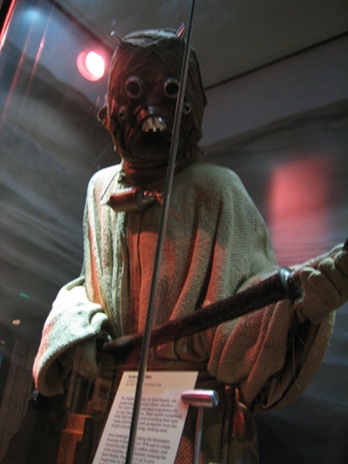
"Tusken Raiders, or Sand People as they are sometimes known, wear abundant clothing to protect themselves from Tatooine’s twin suns. The strong beings pursue a nomadic existence in some of Tatooine’s most desolate regions. They fear little, and make sudden raids on local settlers."
* Fort Worth Museum of Science and History > Star Wars: The Exhibit
"... The Tusken Raiders, or Sand People, are mysterious, dangerous desert dwellers. The local human and Jawa populations try to stay clear of them. Their outfits completely hide their bodies, while providing their eyes, noses, and mouths with protection from bright suns and blowing, choking sand.
"One challenge confronting the filmmakers shooting A New Hope in 1976 was to create convincing aliens using rubber, plastic, and cloth costumes. By completely covering the Sand People, they leave it up to your imagination to decide what the Tusken look like under the wrappings."
Club
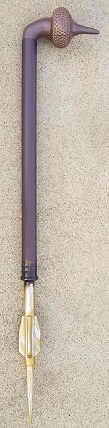
"Gaderffii Stick Also known as a Gaffi Stick, these were the spiked pole arms traditionally wielded by the tribes of Tusken Raiders that were indigenous to Tatooine. Each was unique as they were built with scrounged materials, but were useful as mace-like clubs and for stabbing."