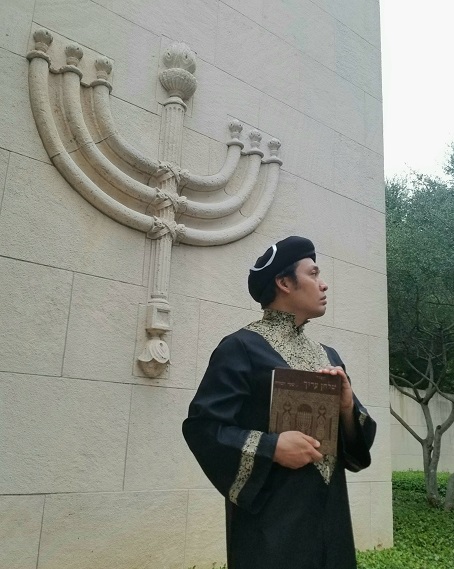
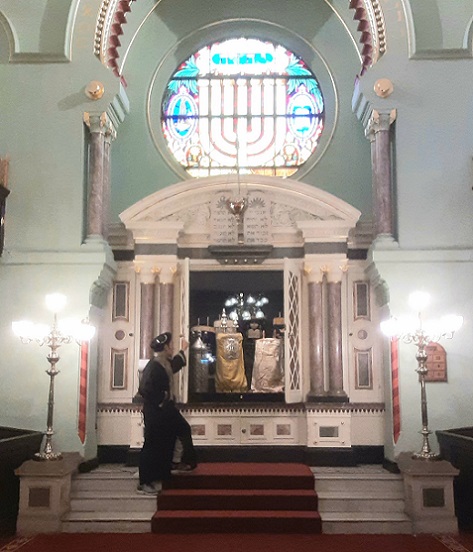
Subject: חָכָם 'wise' scholar
Culture: Sephardi Jew
Setting: Sephardi diaspora 18-20thc
Evolution:
Context (Event Photos, Primary Sources, Secondary Sources, Field Notes)
* Lacave p11-12
"En los siglos XVII y XVIII, hubo algunos tímidos intentos de establecer de nuevo judíos en España, pero no cuajaron. La situacion cambia en el siglo XIX, con la conquista y posterior protectorado español en Marruecos; de entonces datan las autoridades lo toleraban. Al amparo de la Constitución de 1869, que suponía la derogación de aquellas leyes, un cierto número de judíos de Tánger y Tetuán decidieron establecerse en Sevilla, fundando una comunidad que aún perdura. Por otro lado, siguen llegando familias judi'as aisladas, y ya en los primeros años del siglo XX funciona una sinagoga en Madrid.
"Por aquellos años también se plantea el debate, con trascendencia en la opinión del senador Angel Pulido, sobre la reinstalación masiva en España de judíos, en especial de sefardíes; algunos de los cuales pudieron acogerse en años posteriores a la protección de las autoridades consulares españolas, resultando de ello la salvación de judíos por España durante la segunda guerra mundial."
"As social reforms swept through Western Europe, many Jews felt the pressure to 'update' Judaism to conform with their newly acquired 'enlightened' views. This led to the creation of Reform congregations, and by extension, Conservative ones, where the changes were not as drastic.
"Sephardic Jews were largely untouched by those changes, and virtually all Sephardic Jews worship in the traditional Orthodox manner of their ancestors. By and large, even those Sephardim who have drifted from observance tend to be closer to tradition, with a warm place in their hearts for Torah, Torah scholars, and Jewish tradition."
* Museo Sefardi
"En los últimos tiempos se ha ido también extendiendo u nuso impropio de sefardíes para designar a los judíos originarios de países orientales, tanto a los que se han adscrito a la tradición litúrgica o rabínica de Sefarad como a los que no.
"Pero en lengua española sefardíes designa propriamente a los descendientes de los judíos de Sefarad desde su expulsión a fines de la Edad Media y hasta el día de hoy."
* Pulido 2016 p.iv-v
"From the 1500s to 1800s, it was illegal to practice any religion but Catholicism in Spain, and in all those years, few Spaniards ever knowingly met a Jew. In the country's dominant culture, the popular stereotype of this now-absent people was of immoral, greedy, god-murdering moneylenders whose banishment had made Spain a holier, more moral place. The paradox is that while Spain spurned the Jews, countless Sephardim revered their ancestral land. Many families spoke and wrote in Ladino, usually in the Hebrew alphabet, and gave their children and organizations Spanish names. Even in places where the language eventually died out, their liturgy and the names of many synagogues referred to places in Spain.
"This one-sided love affair -- with Spain playing hard to get and numerous Sephardim pining for their former country -- continued into the 1860s. In 1868, after a revolution deposed Isabella II, Jewish leaders in other countries successfully petitioned the acting prime minister to rescind the 1492 decree. Jews could legally enter Spain again, though synagogues were still banned. The next year, a new Constitution established freedom of religion; in the 1880s, the Spanish Crown took the radical step of knighting a Moroccan Sephardic journalist; and in the 1880s and 1890s, Spain repeatedly offered asylum to Jews fleeing from the horrors of Russia's anti-Semitic pogroms and exclusionary laws."
Costume
* Rubens 1973 p
"
* Racinet 1988 p284
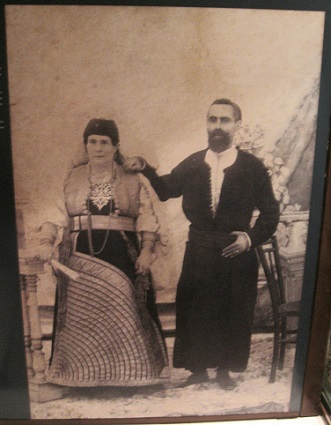
"A haham-bachi -- a Jewish doctor of religion -- from Selanik. His costume is simple: an entari made of striped silk; and a dark overcoat, called a binich."
Cane
"
*
Pointer
*
"