Subject: ज़मींदार zamīndār noble
Culture: Rajput
Setting: Maratha wars / late Mughal empire, Hindustan 18th-early 19thc
Object: तोरादार toradar matchlock musket, barutdan gunpowder horn
Royal Armouries Museum > Oriental Gallery *
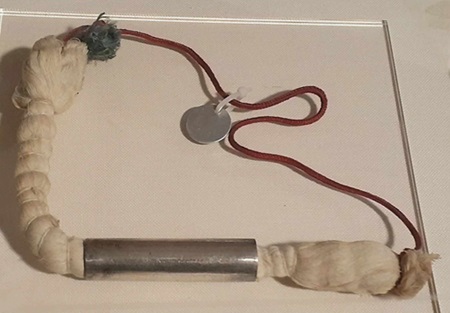
"Match lighter Indian, 19th century The powder in the pan of a musket with no lock mechanism at all
held together by the sliver-covered tube." ...
Royal Armouries Museum > Oriental Gallery *
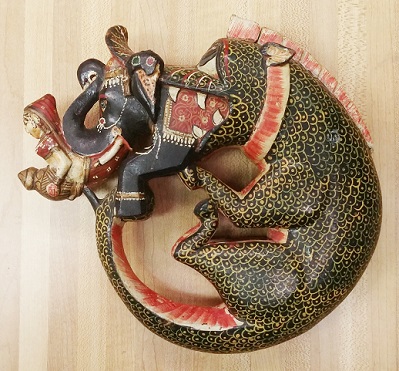
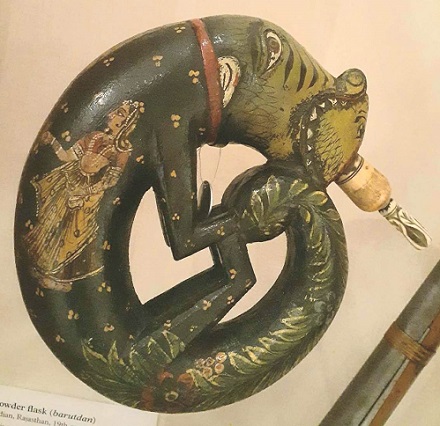
"Powder flask (barutdan) Indian, Rajasthan, 19th century This wooden powder flask is carved in the shape of a sea monster (makara).
The whole is lacquered black with painted decoration. On either side of the body is painted a Rajput lady holding a flask and a cup." ...
*
* Royal Armouries Museum > War Gallery
"Matchlock musket (toradar) Indian, Awadh (Oudh), early 19th century"
* Royal Armouries Museum > War Gallery
"Matchlock musket (toradar) Central Indian, Narwar, 19th century" ....
* Royal Armouries Museum > War Gallery
"Matchlock musket (toradar) Indian, Rajasthan, early 19th century The matchlock musket was the usual weapon of the infantry of the Princely States by the early 19th century. This example is unusual in having two complete lock mechanisms, allowing it to fire two shots." ...
* Curious House
Museu do Oriente *
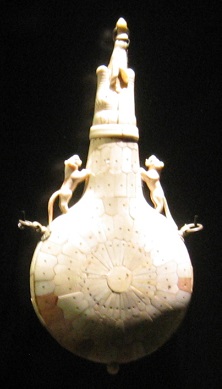
"POWDER FLASK Gujarat? North India? 17th century Ivory, brass, lacquer(?) ...
This type of piece was first produced for western markets and with exports to European precise objects beginning in the late 16th century as Europe. [SIC] Given the fragility of the material and decoration, this powder flask was an adornment used for hunting."
* Royal Armouries Museum > Oriental Gallery
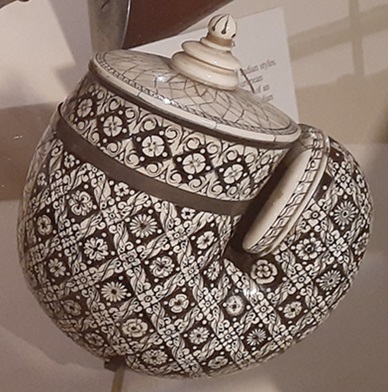
"Powder flask Indian, early 19th century The flask is shaped as a nautilus shell. The decoration is of ivory and ebony carved sections,
finely carved with flowers and foliage. Both ends are capped with ivory, and the nozzle plug is made from turned ivory." ...
Royal Armouries Museum > Oriental Gallery *
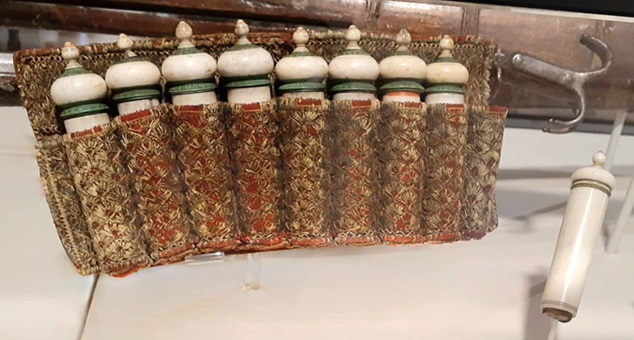
"Cartridge carrier North Indian, early 19th century Covered with red velvet and embroidered with gold thread.
The pouches hold ivory charge holders, carved and stained with green rings." ...
* Royal Armouries Museum > Oriental Gallery
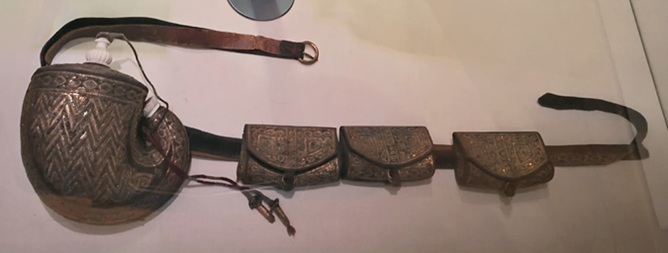
"[....] Very fine belts with pouches and powder flasks such as this were probably for cavalry use." ...
* Royal Armouries Museum > Oriental Gallery
"By the late 18th century a large proportion of north Indian cavalry were armed with firearms. ....
Matchlock muskets, such as the finely decorated hunting gun shown here, were often used on horseback." ...
Royal Armouries Museum > Oriental Gallery *
"Combined matchlock and bow Indian, Rajasthan, early 19th century
This musket has the stock below the ramrod channel slotted to allow a bow string to be inserted.
The bow was lashed to the metal hooks. The bow release mechanism simultaneously applies the match to the pan."
* Royal Armouries Museum > Oriental Gallery
"Matchlock musket (toradar) Indian, Rajasthan, 19th century The barrel on this musket is unusual in that it is of square section.
It has a peep sight in the form of a monster's head. It is fitted to the stock by leather bands." ...