Subject: cuirassier
Culture: Stuart English
Setting: England early-mid 17thc
Virginia Museum of Fine Arts > European Art *
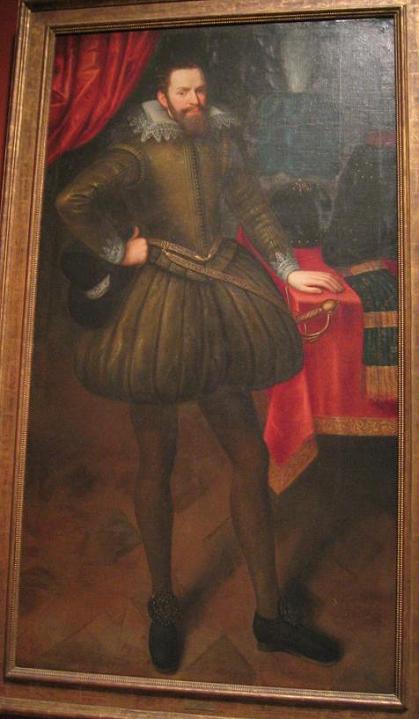
"English or European, early 17th century Sir Thomas Dale, ca. 1607 Oil on canvas Signed, lower right: Sr: THOMAS DALLE / CAP:TN ...
Sir Thomas Dale (ca. 1560s-1619) was an accomplished soldier and efficient administrator; talents acknowledged by King James I, who knighted him in June 1606. Here, he is depicted in fashionable period attire -- flat lace collar, bulbous breeches, and black hose.
The armor on the table behind him indicates his profession as soldier and commander.
"The Virginia Company sought Dale's assistance to revive what was then an ailing colony, and he arrived there on May 10, 1611, to serve as acting deputy governor. In September he led three hundred settlers to form a new township at Henrico,
named in honor of King James's eldest son.
among other things encouraging the marriage of Powhatan's daughter Pocahontas to English settler John Rolfe.
"Though anonymous, this painting is the work of a skilled artist fluent in the international court styles of his day.
Further research may eventually reveal the name and nationality of the painter."
* Royal Armouries Museum > War Gallery
Kimbell Art Museum *
"PETER PAUL RUBENS Flemish, 1577-1640 Equestrian Portrait of the Duke of Buckingham 1625 Oil on panel ...
Peter Paul Rubens was a towering figure in the age of the Baroque, and his influence on later generations of artists was immense. His special position as both painter and diplomat brought him commissions from princely patrons, high-ranking statesmen, and noblemen.
"On a visit to Paris in 1625, Rubens met George Villiers, the first Duke of Buckingham and favorite of King Charles I. The occasion was Charles's marriage-by-proxy to Henrietta Maria, sister of the King of France. One of the chief collectors of his time, Buckingham commissioned a grand equestrian portrait of himself from Rubens. The Kimbell painting was the sketch for that work, which was destroyed by fire in 1949.
"The elegance and bravura that captivated Buckingham's admirers -- and inspired Alexander Dumas' romantic depiction of him in The Three Musketeers -- are evident in Rubens's portrait. As Lord High Admiral of the Navy, the duke lifts his baton as his horse rears on command. Beneath him, the sea god Neptune and a maid adorned with pearls indicate the duke's dominion over the sea.
Overhead, a winged allegory of Fame signals victory with a trumpet in hand.
"Privately Rubens noted Buckingham's 'arrogance and caprice' and predicted that he was 'heading for the precipice.' History proved him correct. The duke's unsuccessful military campaigns against Spain and France were much resented, and in 1628 he was assassinated."