Subject: cuirassier
Culture: Stuart English
Setting: England early-mid 17thc
Object: armor
Royal Ontario Museum > Lobby *
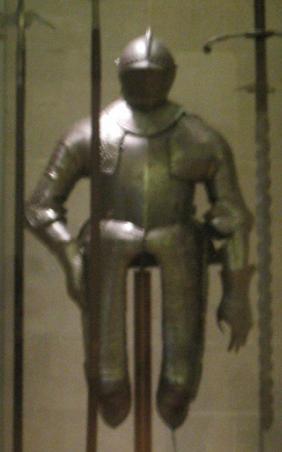
"Armure de cuirassier Angleterre ou Pays-Bas, vers 1630 Provenant du manoir de Cheshunt, Hertfordshire
Plutôt que de porter une lance, les cuirassiers, corps de cavaliers portant une cuirasse,
avaient pour armes des pistolets d'arçon et une épée.
Des armures de ce genre étaient utilisées sur le continent au début de la guerre de Trente Ans (1618-1648)
et en Angleterre au cours des guerres civiles (1642-1651). La marque qui paraît sue le plastron est un poinçon d'essai." ...
* Royal Armouries Museum > War Gallery
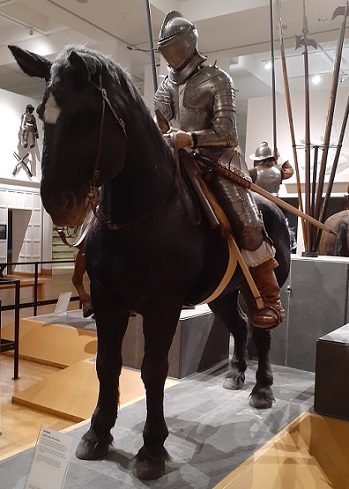
"Armour English, early 17th century. This armour was made for a heavy cavalryman, or cuirassier.
These armours were the fullest armours of their time, which made them the most expensive.
"The Earl of Pembroke's initials can be seen on the knee defences. This shows that this armour belonged to his troops.
"The helmet and cuirass date from the mid-16th century. They have been modified to follow 17th century fashion.
This makes this a very unusual armour." ...
Folger Shakespeare Library > Now Thrive the Armorers: Arms and Armor in Shakespeare *
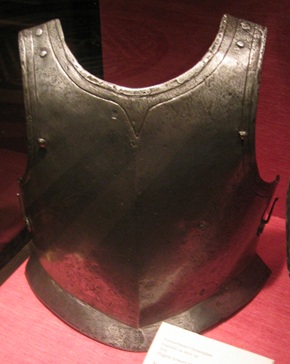
"Harquebusier's breastplate England, ca. 1603-25 Iron ...
Success as a Renaissance monarch depended in part on the ability to maintain substantial stockpiles of arms and armor.
Large numbers of mass-produced items such as this breastplate and the target to its right
were kept in Europe's royal armories to equip armies in times of need. This breastplate bears the mark of the arsenal of James I."