Subject: nobleman, gentleman
Culture: Tudor English
Setting: late Tudor / Elizabethan period, England mid-late 16thc
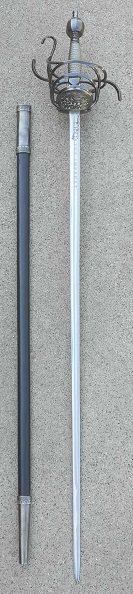
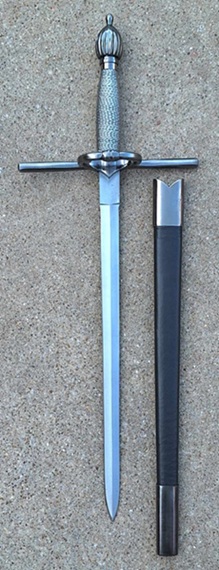
Object: rapier and dagger
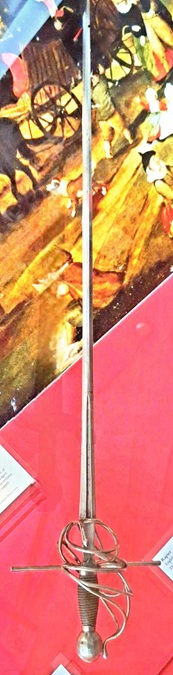
Royal Armouries Museum > Self Defence Gallery *
"Rapier Possibly English, dated 1597
This rapier has a 'swept' hilt of iron and is decorated
with chiselled ornament including the date 1597
Its long blade, of lozenge section, is engraved near the hilt
with the maker's name, Andrea Ferara."
*
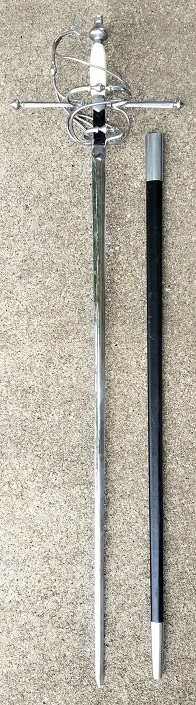
Museum Replicas #501471 *
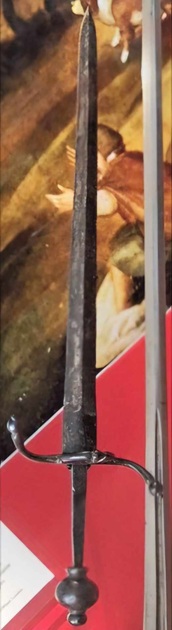
* Royal Armouries Museum > Self Defence Gallery
"Left-hand dagger Probably English, about 1580
This dagger was made to be used in conjunction with a rapier.
Its hilt is of plain iron. One face of its two-edged, hollow-ground
blade bears the remains of a maker's mark inlaid in copper." ...
* Royal Armouries Museum > Self Defence Gallery
"Rapier Possibly English, about 1590 With a 'swept' hilt of chiselled iron.
Preserved with the rapier are a byknife for domestic use,
fragments of the scabbard, the lower scabbard-mount (chape)
and two buckles and a fragment of the sword-belt." ...
Windlass Steelcrafts *
* Royal Armouries Museum > Self Defence Gallery
"Rapier English, late 16th century This rapier has a 'swept' hilt of iron.
It retains its original wire-bound grip. The blade, of hexagonal cross-section,
is inscribed near the hilt on each side with its place of manufacture in
Solingen, Germany." ...
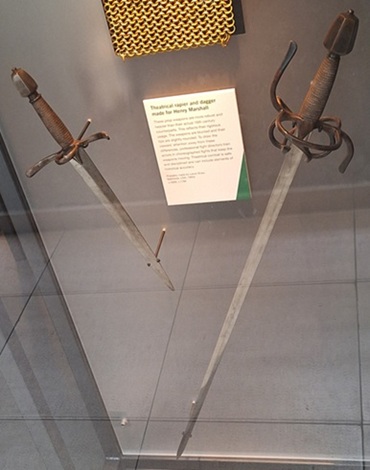
* Royal Armouries Museum > Make/Believe
"Theatrical rapier and dagger made for Henry Marshall
These prop weapons are more robust and heavier than their actual 16th century counterparts.
This reflects their rigorous usage. The weapons are blunted and their tips are slightly rounded.
To draw the viewers' attention away from these differences, professional fights that keep the weapons moving.
Theatrical combat is safe and disciplined and can include elements of historical accuracy.
Probably made by Lewis Shaw, Baltimore, USA, 1960s" ...