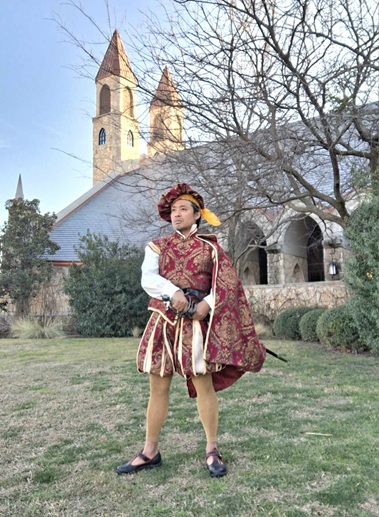
Subject: nobleman, gentleman
Culture: Tudor English
Setting: late Tudor / Elizabethan period, England mid-late 16thc
Event Photos
* Moore 2016 p6
"Swords or rapiers crop up occasionally in cases of Tudor murder, usually involving the upper echelons of society."
* Wrightson 1982 p160
"The circumstances of violent death do ... suggest that this was a society in which violence might be resorted to comparatively readily. This should not be exaggerated. There were few deaths as a result of armed affrays or private wars; although these could still occur, as in 1589 when Sir Thomas Langton and eighty men attacked. ... But such events were uncommon and increasingly anachronistic, even in the supposedly lawless north of England. Most gentlemen settled their disputes at law, as indeed did many of their social inferiors. Nevertheless, the evidence of homicide cases carries the implication that many people were volatile and that quarrels could easily degenerate into violence, especially when assisted by drink."
* Haynes 1997 p79-80
"Given the evidence of rampant sexuality about him the young urban male was probably frustrated and angry, but defying social conventions was always a risky business -- tender girls may have irate fathers. There was the infamous double standard that chastised her for sexual experiment but expected him to latch on to it. Privileged young men in the universities and the Inns of Court may have had sisters and female cousins but family duty commended them to defend them if fathers failed. Moreover, their own primary dealings were with other young men leading to bravura exhibitions for each other. Apprentices too had the same impulses to fight, drink and rouse the watch with ludic excesses."
Primary Sources
* Strong 1977 p161-162
".... [T]he use and cultivation of the imagery and motifs of legends of chivalry formed an integral part of the official 'image' projected by sixteenth-century monarchs. Through them they were able to surround the actualities of present-day politics with the sanctions of historical myth and legend. In a century of violent political and religious upheaval, of cosmic proportions to those who lived through it, this was of immense importance in preserving an illusion of continuity. ... [T]he sermons and other literature which marked the popular celebration of the day made it an anti-papal triumph, a day when a pure Virgin Queen ushed in the word of the Gospel and vanquished the impure Pope of Rome and the baneful influence of his adherents. The idea of adorning this with the time-honoured imagery and ceremonial of medieval chivalry was an infinite subtlety of which the organizers were no doubt well aware. It is one of eth great paradoxes of the Elizabethan world, one of its touchstones, that an age of social, political and religious revolution should cling to and deliberately erect a façade of the trappings of feudalism."
Secondary Sources
*
"
Field Notes
1.