Subject: bravo bandit/mercenary
Culture: Venetian
Setting: Venetian republic 16th-17thc
Kimbell Art Museum *
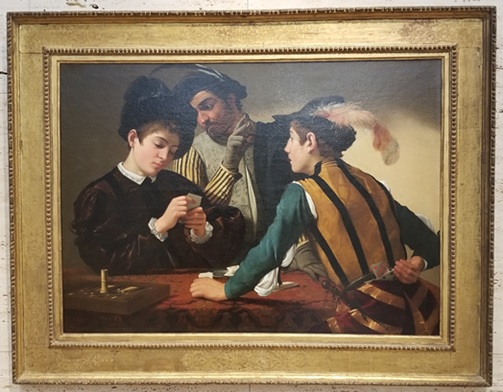
"The Cardsharps, c. 1596–97 Caravaggio (Michelangelo Merisi), Italian Caravaggio was one of the pivotal figures in the history of Western art.
In his short lifetime, he created a theatrical style that was as shocking to some as it was new, inspiring others to probe their subject matter for the drama of psychological relationships. Apprenticed in Milan, Caravaggio came to Rome about 1595. There his early masterpiece The Cardsharps came to the attention of the influential Cardinal Francesco Maria del Monte, who not only purchased it but also offered the artist quarters in his palace. Caravaggio was thus introduced to the elite stratum of Roman ecclesiastical society,
which soon gave him his first significant opportunity to work on a large scale and for a public forum.
"In The Cardsharps, the players are engaged in a game of primero, a forerunner of poker. Engrossed in his cards at left is the dupe, unaware that the older cardsharp signals his accomplice with a raised, gloved hand (the fingertips exposed, better to feel marked cards). At right, the young cheat looks expectantly toward the boy and reaches behind his back to pull a hidden card from his breeches. Caravaggio has treated this subject not as a caricature of vice but in a novelistic way, in which the interaction of gesture and glance evokes the drama of deception and lost innocence in the most human of terms. The Cardsharps spawned countless paintings on related themes by artists throughout Europe—not the least of which was Georges de La Tour’s Cheat with the Ace of Clubs in the Kimbell. The Cardsharps was stamped on the back with the seal of Cardinal del Monte and inventoried among his possessions after his death in 1627. Its location had been unknown for some ninety years when it was rediscovered in 1987 in a European private collection."
* National Gallery of Art > West Building
LUCA SIGNORELLI Umbrian, 1445/1450-1523"
National Gallery of Art > West Building *
DOSSO DOSSI Ferrarese, active 1512-1542"
* National Gallery of Art > West Building
"Vincenzo Capello oil on canvas, probably c. 1540
TITIAN Venetian, c. 1490-1576" ...
National Gallery of Art > West Building *
"Portrait of a Gentleman oil on panel transferred to canvas, c. 1520
BARTOLOMEO VENETO Lombard-Venetian, active 1502-1531" ...
* National Gallery of Art > West Building
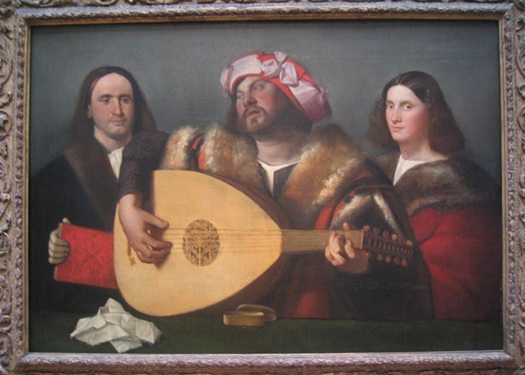
"A Concert oil on canvas, c.1518-1520 GIOVANNI CARIANI Venetian, 1485/1490-1547 or after" ...
Dallas Museum of Art *
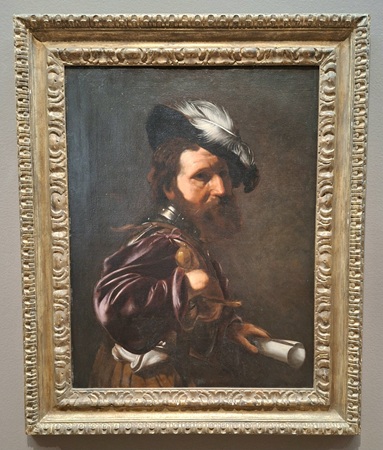
"A Bravo Figure About 1605 Bartolomeo Manfredi Born in Ostiano, Italy, 1582-died in Rome, Italy, 1622 Oil on canvas
Manfredi was a Baroque painter and a follower of one of the most infamous artists of his time, Michelangelo Merisi da Caravaggio, whom he met while living in Rome in the early 1600s. Both artists shared a fondness for the dramatic treatment of light and shade (known as chiaroscuro), naturalistic renderings of figures, and shallow compositions that place us close to the action. Manfredi was known for everyday scenes like this painting of a bravo -- a mercenary identified by his armor and sword. The bravo leans forward,
one hand resting on the hilt of his sword and the other clutching rolled parchment, and casts a furtive glance at the viewer." ...
"Figura de un bravo Aproximadamente 1605 Bartolomeo Manfredi Nacido en Ostiano, Italia, en 1582-fallecido en Roma, Italia, en 1622 Óleo sobre lienzo Manfredi fue un pinto barroco seguidor de uno de los artistas más famosos de su época, Michelangelo Merisi da Caravaggio, a quien conoció cuando vivía en Roma a principios del siglo XVII. Ambos artista compartían la afición por el tratamiento dramático de la luz y la sombra (conocido como claroscuro), las representaciones naturalistas de las figuras y las composiciones poco profundas que nos sitúan cerca de la acción. Manfredi era conocido por sus escenas cotidianas, como este cuadro de un bravo un mercenario identificado por su armadura y su espada. El bravo se inclina hacia delante, con una mano apoyada en la empuñadura de su espada y la otra agarrando un pergamino enrollado,
y lanza una mirada furtiva al espectador." ...