Subject: Ritter knight
Culture: Imperial German
Setting: Holy Roman Empire, central Europe late 15thc
Object: Schwert sword
Royal Ontario Museum *
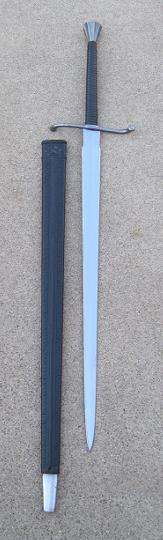
"1470-1480 German or Netherlandish. Steel, iron cross and pommel, traces of wooden grip. ...
A hand-and-a-half sword. The long blade -- relatively slender, acutely pointed, and of stout cross-section -- is similar to many swords of the 1400s, designed for both cutting and thrusting. The elongated pommel and the S-shaped cross guard are also typical for that time."
"1470-1480 Allemagne ou Pay-Bas. Acier, quillons et pommeau en fer, traces d'un fusée en bois. ... Épée à une main et demie. La longue lame, assez fine et extrêmement pointue, et qui est transversalement épaisse, se recontre sur beaucoup d'épées du XVe siècle destinées à trancher et à percer. Le pommeau allongé et les quillons en forme de << S >> sont aussi typiques de cette époque."
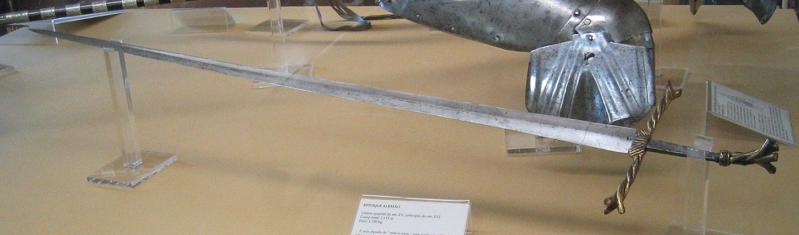
* Museu Militar
"ESTOQUE ALEMÃO Ultimo quartel do séc.XV, principio do séc.XVI Comp.total: 1,115 m Peso: 1,150 kg
É um espada de 'mão-e-meia' pois podia ser utilizada com uma ou duas mãos.
"Tem um punção que indica ter sido feito por Johann Wender célebre espadeiro alemão."
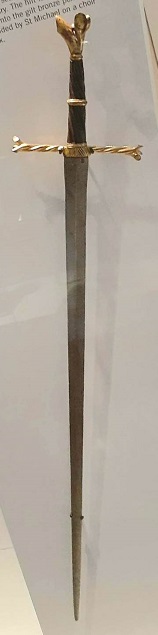
* Royal Armouries Museum > War Gallery
"Writhen Hilt Sword German, About 1480 This sword was part of the Spitzer collection before being acquired by media magnate, William Randolph Hearst. There is an organic, natural quality to this sword that truly sets it apart from the many utilitarian weapons of the 15th Century. The hilt is of wood carved to resemble a gnarled stave flowing into the gilt bronze pommel and quillons. A similar sword is wielded by St Michael on a choir screen in Ranworth Church, Norfolk."